







Australian Open 411: Everything to know about the season's first Grand Slam
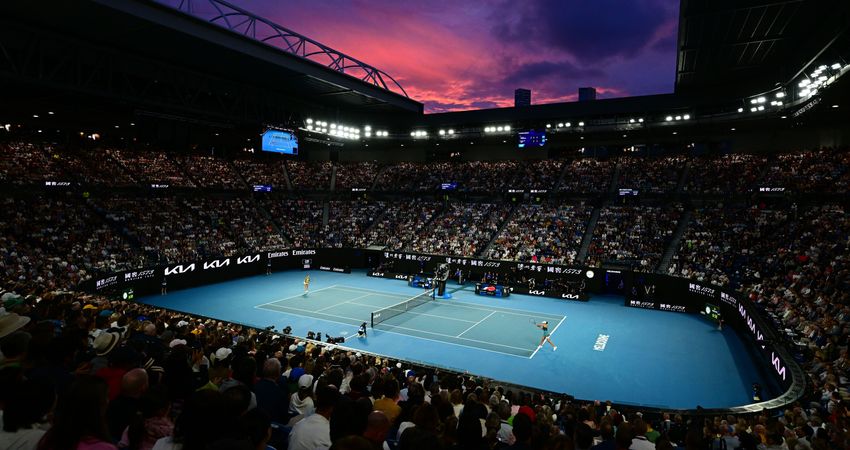

MELBOURNE, Australia -- The main draw of the 2026 Australian Open is just a few days away as the world's best on the WTA Tour Driven by Mercedes-Benz head to Melbourne Park, all vying for a chance at the season's first Grand Slam.
Madison Keys, who won her first career Grand Slam title last year in Melbourne, looks to defend her title, while Iga Swiatek enters with a chance at the career Slam. The field is also headlined by four previous Australian Open champions, including Aryna Sabalenka, Naomi Osaka and Sofia Kenin.
What are the dates for each round?
Matches from Melbourne Park will begin on Sunday, Jan. 18 and end with the finals on Saturday, Jan. 31. Here are the scheduled dates for each of the draws:
Singles
First round: Jan. 18-20
Second round: Jan. 21-22
Third round: Jan. 23-24
Fourth round: Jan. 25-26
Quarterfinals: Jan. 27-28
Semifinals: Jan. 29
Final: Jan. 31
Doubles
First round: Jan. 20-22
Second round: Jan. 23-24
Third round: Jan. 25-26
Quarterfinals: Jan. 27-28
Semifinals: Jan. 29
Final: Jan. 31
If a player is in both the singles and doubles final, the doubles final will be moved to Feb. 1.
What is the singles draw and what are the potential matches to watch?
The singles main draw was released Thursday, Jan. 15 with Aryna Sabalenka leading the first quarter that also includes Victoria Mboko, Emma Raducanu and Jasmine Paolini. Coco Gauff tops the second quarter and could face Venus Williams in the second round.
Americans Amanda Anisimova and Jessica Pegula are the highest seeds in the third quarter that features defending champion Keys. In the fourth quarter, six-time Grand Slam champion Swiatek and 2025 WTA Finals Riyadh champion Elena Rybakina headline that part of the draw.
Australian Open draw preview: Keys could face Pegula, Anisimova in path to defend title
Who are the top seeds and notable wildcards?
Of the 32 seeded players, 10 have previously won a Grand Slam, including four who have won Australian Open titles.
Seeds:
- 1) Aryna Sabalenka 2) Iga Swiatek 3) Coco Gauff 4) Amanda Anisimova 5) Elena Rybakina 6) Jessica Pegula 7) Madison Keys 8) Jasmine Paolini
- 9) Mirra Andreeva 10) Belinda Bencic 11) Ekaterina Alexandrova 12) Clara Tauson 13) Linda Noskova 14) Elina Svitolina 15) Emma Navarro 16) Naomi Osaka
- 17) Victoria Mboko 18) Liuidmila Samsonova 19) Karolina Muchova 20) Marta Kostyuk 21) Elise Mertens 22) Leylah Fernandez 23) Diana Shnaider 24) Jelena Ostapenko
- 25) Paula Badosa 26) Dayana Yastremska 27) Sofia Kenin 28) Emma Raducanu 29) Iva Jovic 30) Maya Joint 31) Anna Kalinskaya 32) Marketa Vondrousova
Notable wild cards:
- Venus Williams: Seven-time Grand Slam winner and two-time finalist of the Australian Open, Williams, 45, received a wild card for the Slam. She had tune-up tournaments at the WTA 250 tournaments in Auckland and Hobart before Melbourne.
- Emerson Jones: Former junior No. 1 from Queensland, Australia, Jones received her second wild card to her country's premier event. Last year, she fell to Rybakina in straight sets in the first round. In 2026, she will face Mboko in the first round.
- Tiantsoa Rakotomanga Rajaonah: The Frenchwoman made her tour-level debut in April of last year followed by her Grand Slam main-draw debut at Roland Garros shortly after. By the end of 2025, she reached a career-high rank of No. 119 and won her first title in Sao Paulo, Brazil.
Who is the defending champion?
Keys won her first career Grand Slam in Melbourne a year ago, defeating Sabalenka in the final 6-3, 2-6, 7-5. En route to the championship, she had to withstand three Grand Slam champions in Sabalenka, Swiatek in the semifinal and Rybakina in the quarterfinal.
The Australian Open run capped off a terrific summer Down Under as she won the Adelaide International the week before. Ultimately, her 16-match win streak that started in Adelaide did not end until the semifinals at Indian Wells in March.
What are the ranking points and prize money at stake?
Tennis Australia recently announced a record prize pool of AUD $111.5 million (USD $74.9 million), which is a 16% increase from last year’s tournament and the most in the tournament’s history. All singles and doubles players will receive a minimum 10% increase.
As with all Grand Slams, 2,000 rankings points will be available for both singles and doubles. Based on how far a player advances, below is the prize money in AUD and rankings points earned for reaching that round:
Singles (Prize money | ranking points)
First Round: $150,000 (USD $100,760) | 10
Second Round: $225,000 (USD $151,139) | 70
Third Round: $327,750 (USD $220,159) | 130
Fourth Round: $480,000 (USD $322,430) | 240
Quarterfinals: $750,000 (USD $503,795) | 430
Semifinals: $1.25 million (USD 840,000) | 780
Finalist: $2.15 million (USD $1.44 million) | 1300
Champion: $4.1 million (USD $2.75 million) | 2000
Qualifiers
Round 1: $40,500 (USD $27,205) | 2
Round 2: $57,000 (USD $38,288) | 20
Round 3: $83,500 (USD $56,089) | 30
Qualified: 40 ranking points
Doubles
First Round: $44,000 (USD $29,556) | 10
Second Round: $64,000 (USD $42,990) | 130
Third Round: $92,000 (USD $61,799) | 240
Quarterfinals: $158,000 (USD $106,133) | 430
Semifinals: $275,000 (USD $184,725) | 780
Finalist: $485,000 (USD $325,788) | 1300
Champion: $900,000 (USD $604,554) | 2000